Best Gold Pans
Just so you know, some links on this page are affiliate links. If you buy something via them, we get a small kickback. You don't pay more, but it helps toward the next hunt.
Six gold pans compared, and what the riffle pattern actually does
Not sure which gear is right for you? Take the Nugget Scout Quiz for a personalized recommendation based on your terrain, budget, and experience level.
A gold pan costs next to nothing. That's the entire barrier to entry for one of the oldest ways to find gold in the world. You can be standing in a California creek pulling color from the streambed this weekend, no permit required in most BLM creek country, no expensive gear, no prior experience. The only questions are whether you have the right pan and know the technique.
Affiliate disclosure: some links in this guide may earn me a commission, at no extra cost to you.
Most gold pan reviews compare colors and brand names. Here's what actually matters.
Not sure which setup is right for you?
Take Our QuizThe one number that matters: pan diameter
Pan size determines how much material you can work per hour. A 14-inch pan holds roughly twice the material of a 10-inch pan. More material per cycle means more ground covered per day.
The trade-off is weight. A full 14-inch pan loaded with wet gravel weighs around 6 to 8 pounds. After four hours of panning, arm fatigue becomes a variable. The 10-inch backpacker pan was designed for concentrating, running smaller loads of material that's already been classified down.
For general creek panning where you're processing raw gravel, start with a 14-inch pan. The classifier screens oversized material before it reaches the pan, so you're not panning whole creek gravel, you're panning classified material, which is lighter and works faster.
Why black plastic
You want a black pan. Not green, not blue. Black.
Gold is yellow. Against a black background, even a tiny flake is visible. Against a green background, fine gold is difficult to spot in low light. Prospectors miss color in a green pan that they would have caught immediately in a black one.
The one exception: blue bowl concentrators use a specific blue color chosen for contrast with black sand after the magnet has been run. That's a different tool with a different purpose.
Riffle geometry
The riffles, the ridges inside the pan, trap heavy material as you swirl water over the lip. Riffle design is the main way pans differ from each other functionally.
Coarse riffles trap larger, heavier gold well. They're effective for nugget hunting and processing gravel from known productive ground.
Fine riffles in a secondary inner ring catch smaller material, fine flakes, sub-millimeter particles. A pan with both coarse outer riffles and fine inner riffles covers the widest range of gold sizes.
Smooth-bottomed pans exist, primarily for final cleanup. After you've concentrated material down to black sand and potential gold with a riffled pan, running the final cleanup in a smooth pan makes individual particles easier to control.
Best all-around pan: Garrett Prospector 14"
The Garrett 14-inch Prospector is the pan to buy when starting out. It's the most consistently recommended pan in the gold panning community for good reason.
The dual riffle system, deeper outer riffles for coarse gold, shallower inner riffles for fine flakes, handles a wider range of gold sizes than single-riffle designs. Black plastic. True 14-inch diameter. Virtually indestructible.
There's no reason to overthink the pan choice when you're starting. Buy this one, learn on it, and if you eventually decide you need a specialized tool for fine gold or concentrating, buy one of those specifically. The Garrett does the general job well.
Best complete starter kit: Garrett Complete Gold Pan Kit
If you want to show up at a creek with everything you need and nothing missing, buy the complete kit instead of the pan alone.
What matters in the kit that beginners consistently forget to buy separately:
The classifier. A classifier, a mesh screen that sits inside a 5-gallon bucket, removes oversized material before it enters the pan. Rock fragments, pebbles, and oversize gravel don't pan efficiently and add significant weight and time per cycle. Most beginners buy a pan, head to the creek, start loading whole gravel directly into the pan, and wonder why it takes 20 minutes per load and they keep losing material. Classify first, then pan. The classifier is what makes that possible.
The snuffer bottle. Once you've panned down to color, fine flakes in black sand, you need a way to pick up individual particles without losing them. The snuffer bottle works by squeezing to create suction. You can't pick up flour gold flakes with tweezers reliably. The snuffer is the tool for the job.
The kit includes the 14-inch Gold Trap pan, a classifier/sifter, a 10-inch backpacker pan for concentrating, the Gold Guzzler snuffer bottle, and two vials for storage. Everything you need. Under $50.
Pan care
New plastic pans have a surface residue from the manufacturing process that can repel fine gold, gold floats on it. Before using a new plastic pan, wash it with dish soap and hot water, then boil it for 10 minutes if possible. This removes the residue and makes the surface rough enough to grip gold particles.
Don't use a riffled pan as a scrub brush or cutting surface. The riffles are the functional part of the pan. Damage them and the pan traps gold less effectively.
After a day of panning, rinse the pan thoroughly and dry it. Small particles of heavy black sand left in the riffles can scratch the surface over time.
The panning technique that actually works
Most beginners learn to pan incorrectly and wonder why they keep losing gold. Here's the sequence that works.
Step one: classify before you pan. Load your classifier screen over a bucket or directly over the pan. Fill the classifier with gravel from the creek or streambed. Shake it side to side and up and down while submerged in water. Material smaller than the mesh falls through; oversized material stays in the classifier. Dump the oversized material and work with what passed through. This removes material that's too large to process efficiently and too light to carry gold.
Step two: load the pan about two-thirds full. Not to the rim. Two-thirds gives you room to work material without spilling. Submerge the pan in the water.
Step three: break up the material. Gold concentrates under vegetation and clay. Work your fingers through the classified material, breaking up clay balls and dispersing any organic matter. Clay holds fine gold in clumps, if you don't break it up, you'll pan it out intact.
Step four: shake to settle gold. Gold is heavy: 19.3 grams per cubic centimeter versus 2.5 for gravel. When you shake the pan horizontally while submerged, heavy material migrates to the bottom. Shake for 30 to 45 seconds with the pan flat and level.
Step five: tilt and wash. Tilt the pan forward about 20 to 30 degrees. Use a circular sloshing motion to move water across the surface and off the forward edge. Light material, sand, fine gravel, organic material, washes over the lip. Heavy material stays in the riffles.
Step six: repeat. Continue the tilt-and-wash cycle, periodically re-leveling to shake gold back down, until you have a small amount of material remaining, mostly black sand with any gold present.
Step seven: final cleanup. Reduce the pan to about a cup of water and the remaining concentrate. Tilt the pan nearly flat and rotate it slowly in one direction. The black sand and gold will separate by density, black sand moves first, gold lags behind. You'll see color, if present, as a trailing streak.
The most common error is working too fast. Going slowly keeps gold from washing over the lip. A properly panned load takes three to five minutes. If you're finishing in 60 seconds, you're moving material too quickly.
Where to find gold in a creek, the actual locations
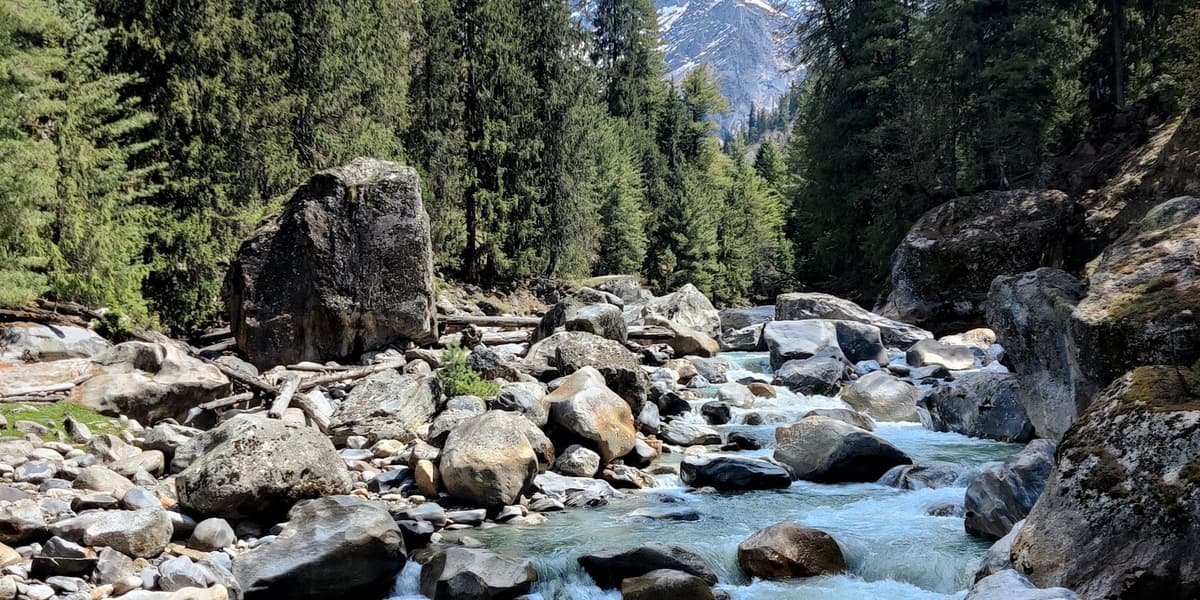
Knowing how to pan matters less than knowing where to dig. Gold follows the physics of moving water: it drops wherever the current slows.
Inside bends. Water moves faster on the outside of a curve and slower on the inside. The slower inside current drops heavy material, including gold. Look at the inside gravel bar. The heaviest material concentrates where the slowest water deposits it, typically just below the apex of the bend.
Behind large boulders and bedrock outcrops. Any obstruction creates a low-pressure zone immediately downstream where current drops material. Dig in the downstream shadow of boulders. Dig in pockets in bedrock.
At bedrock contact. Gold sinks until it hits something it can't penetrate. Where bedrock is at or near the surface, exposed in the creek bed or visible under a thin layer of gravel, dig down to it. Gold accumulates in cracks, pockets, and depressions in the bedrock surface. A flat pry bar and stiff brush are useful for cleaning bedrock pockets.
At gradient changes. Where a fast-moving riffle section transitions to a deeper pool, the current slows abruptly. Heavy material drops at the transition. Dig at the tail end of riffles where they meet the pool.
Old high-water channels. During high water, gold distributes itself across a wider area. Low benches above the current waterline can contain gold deposited during historical floods. These are often overlooked, everyone pans the active streambed, fewer people work the adjacent benches.
Black sand and what to do with it
After panning, you're left with black sand, primarily magnetite and hematite, mixed with any gold present. This is where beginners lose fine gold.
Run a magnet. Wrap a magnet in a thin plastic bag, hold it just above the wet black sand in the pan, and the magnetic black sand will leap to it. Remove the magnet-and-bag together, peel the bag inside out to release the sand, repeat until no more sand responds. This removes magnetic black sand cleanly.
Not all black sand is magnetic. Hematite is weakly magnetic. Ilmenite and cassiterite are not magnetic at all. After the magnet pass, you'll still have some dark heavy minerals mixed with any gold.
Use the snuffer bottle for recovery. With the remaining material in a small amount of water, use the snuffer bottle by squeezing it, positioning the tip near the gold particle, and releasing, suction captures the particle. This is how you recover fine gold and flour gold from the pan without losing it between your fingers.
Final pan work. For sub-millimeter gold, the final pan technique requires almost no water and very slow rotation. The gold will show as a bright yellow or orange streak against the dark concentrate. Take your time, rushing this step is how you lose the gold you panned for.
Common panning mistakes and how to fix them
Panning too fast. The most common error. Material exits the pan before it's properly stratified. Fix: slow the circular wash motion, give heavy material time to settle between washes.
Skipping the classifier. Loading unclassified gravel directly into the pan means you're working large material that doesn't pan efficiently and obscures the fine stuff at the bottom. Fix: always classify first.
Not breaking up clay. Clay balls pass intact through panning and carry gold with them. Fix: work fingers through the material before you start panning, especially in creek gravels with visible clay content.
Panning dry material. You need the pan submerged or at least wet throughout. Dry material doesn't stratify. Fix: keep the pan in or just above water during the entire process.
Rushing the final cleanup. The last inch of black sand is where your gold is. People rush this stage after spending four minutes doing everything else right. Fix: take three minutes for the final cleanup. The gold isn't going anywhere.
When to upgrade
The Garrett 14-inch pan handles everything most prospectors will ever encounter. The situations where you'd look at a different tool:
Concentrating sluice output. A 10-inch smooth-bottomed pan lets you work small volumes of already-concentrated material with precision. The Garrett backpacker pan in the complete kit handles this.
Fine gold recovery. If you're consistently finding that you have black sand left after panning but suspect there's fine gold in it, a blue bowl or spiral wheel concentrator works better than continued hand-panning for that material. These are separate tools for a specific problem.
High volume. If you're processing large volumes of material, sluice or high banker output, a 14-inch pan works fine. There's no benefit to a larger pan for most recreational prospectors.
For the vast majority of gold panning: the Garrett 14-inch pan covers everything you'll encounter.
What to Avoid
Green pans for primary use. Green pans come standard in many starter kits. Against a green background, fine gold, especially flour gold and small flakes, is genuinely harder to see in variable light. Black pans are the standard for good reason. If a kit comes with a green pan, use it for classification but use black for the final work.
Aluminum pans. Aluminum gold pans are technically functional. The problem is surface chemistry: aluminum develops a thin oxide layer that can behave unpredictably with fine gold in some water conditions. Black plastic doesn't have this issue. There's no reason to use aluminum when a better-performing black plastic pan costs the same or less.
Pans with steep vertical sidewalls. Some decorative pans have nearly vertical sides. The classic pan geometry, angled sides at 30 to 45 degrees, exists because it works. The angle controls how material slides toward the lip during tilt-and-wash. Vertical-sided pans disrupt that mechanics.
Cheap "complete" kits from unknown Amazon brands. These appear at low prices with impressive-looking contents. The plastic quality is substandard, thinner walls, rough molding lines in the riffles, inconsistent geometry. The Garrett complete kit is manufactured to a known standard. The few extra dollars are worth it.
The Garrett 14-inch pan and a weekend at a creek is where this hobby starts. Some of the most productive gold country in the US, the American River drainage in California, creeks throughout western Nevada, streams in the Montana gold belt, is open BLM land where anyone can prospect. Find a productive area, work the inside bends, dig to bedrock. The equipment is the simplest part.
The practical rule: avoid anything that isn't a dedicated gold pan, and avoid kits that don't include a black plastic pan. Most gear decisions in gold prospecting are reversible. Starting with the wrong pan shape is a minor frustration you can fix with a $15 replacement.
The bottom line on gold pans: start with a 14-inch black plastic pan with deep riffles. The Garrett Prospector or any equivalent black pan gets the job done. Add a classifier screen on your second trip. Skip the green pans, skip the steel pans, skip the gimmick shapes. Learn to read black sand concentrates in a standard pan before you optimize anything else. The fundamentals of panning technique matter more than any equipment choice at this level.
For the panning technique itself, the how to pan for gold guide covers the full process.
Find Your Right Gear
Answer a few quick questions and get personalized gear recommendations.
Start the QuizFrequently Asked Questions
What size gold pan should I buy?
A 14-inch pan handles more material and is better for creek work. A 10-inch pan is lighter and better for working tight spots or concentrating down from a sluice. Most prospectors end up owning both.
What color gold pan is best: black or green?
Black is better for visibility. Gold shows clearly against the dark background. Green works but is harder to spot fine gold in low light. Avoid blue or other colors.
What are the riffles on a gold pan for?
Riffles are the angled ridges inside the pan that trap gold as you swirl water. Deeper riffles catch coarser gold. Shallower, finer riffles catch smaller flakes. A pan with both inner and outer riffle systems handles a wider range of gold sizes.
Related Guides
Not sure which guide applies to you?
Take the quiz. Tell me where you're prospecting and I'll tell you what to buy.
Take the Quiz — It's FreeNo email required